


Focusing on filtration screens
filters, strainers, baskets, cones, cartridges
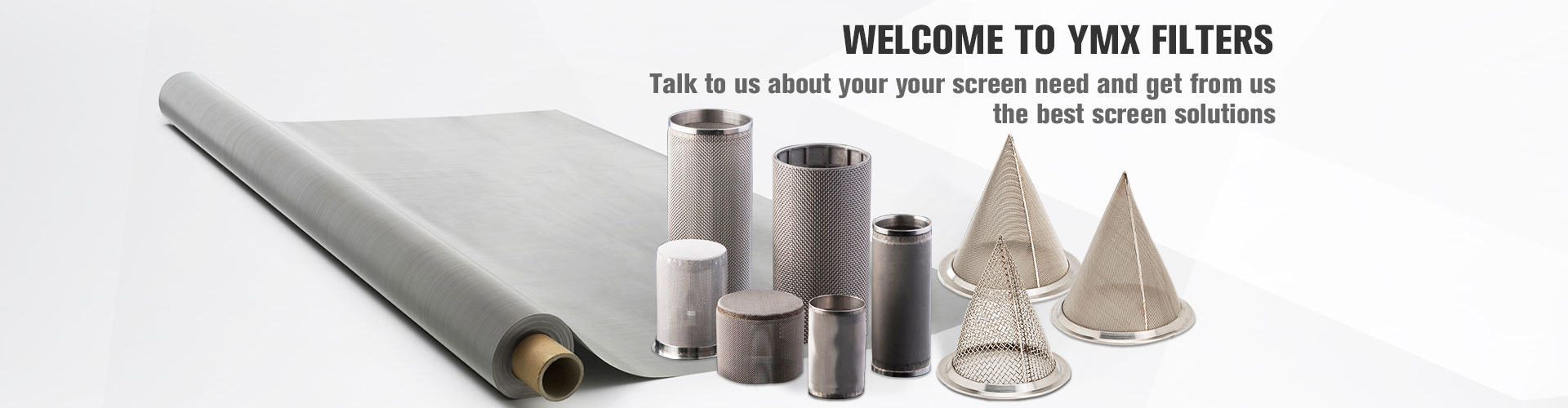
YMX is a filter cartridge supplier producing stainless steel mesh cartridges for liquid and gas filtration systems. Available structures include straight cylindrical mesh tubes, dip tube filters, pleated wire mesh cartridges and supported filter elements.
Each cartridge can be manufactured according to the available installation space, required filtration rating, flow direction, operating pressure and connection structure. Customers can specify the outside diameter, inside diameter, overall length, mesh structure, support core, end caps and sealing method.
Cylindrical filter cartridges use woven wire mesh formed around a round support structure. Their compact shape allows filtration around the entire circumference of the cartridge.
They can be manufactured with:
Single-layer or multilayer wire mesh
Open or closed ends
Internal or external support tubes
Welded longitudinal seams
Plain, threaded or flanged connections
Removable or permanently installed structures
The diameter, length and end configuration should be matched to the filter housing or equipment inlet.
Pleated filter cartridges fold the filtration medium into repeated pleats around a cylindrical support core. This structure increases the available filtration area without requiring a much larger cartridge diameter.
Pleated designs are suitable when the buyer requires:
More filtration area within limited installation space
Lower surface loading on the filtration medium
Longer operating intervals between cleaning
Improved dirt-holding capacity
A reusable metallic filter element
Pleat height, pleat quantity and spacing must be balanced carefully. Very dense pleats may increase nominal surface area but can restrict flow and make cleaning more difficult.
Dip tube filters are installed at the end of a suction or liquid-transfer tube. The cylindrical mesh section prevents larger contaminants from entering the tube while allowing the liquid to pass through the surrounding filter surface.
Important specifications include:
Tube connection size
Cartridge outside diameter
Overall length
Mesh opening
Closed-end structure
Required flow rate
Installation direction
The connection must be compatible with the existing tube or fitting to prevent leakage or loosening during operation.
Fine wire mesh may require an inner core or outer protective cage to prevent deformation. Supported filter cartridges can combine filtration mesh with perforated metal, expanded metal or coarse woven mesh.
The supporting structure should be selected according to:
Pressure differential
Direction of flow
Cartridge length
Mesh strength
Cleaning method
Risk of impact or handling damage
A long cartridge or fine filtration layer generally requires more structural support than a short, coarse-mesh tube.
The intended flow direction should be confirmed before cartridge production.
Outside-to-inside flow allows contaminants to collect on the outer surface of the cartridge. This arrangement usually makes the contamination easier to inspect and clean.
Inside-to-outside flow collects particles on the inner surface. In this structure, the outer supporting layer may need to resist expansion and prevent the filtration mesh from deforming.
The flow direction affects the position of the support core, protective layer and sealing components. It should therefore be indicated on the drawing or inquiry.
Cartridge selection should not be based only on the nominal micron rating. The usable filtration area also affects flow resistance, contamination capacity and cleaning frequency.
A larger diameter or longer cartridge provides more surface area. A pleated design can further increase the filtration area within the same housing dimensions.
The appropriate structure depends on:
Required flow rate
Fluid viscosity
Particle concentration
Filtration rating
Allowable pressure loss
Available installation space
Cleaning frequency
Expected operating cycle
When installation space is limited, a pleated cartridge may provide more filtration area than a straight cylindrical mesh tube.
Filter cartridges can be manufactured from stainless steel woven wire mesh or metallic porous filtration media.
Available structures may include:
Plain woven mesh
Twill woven mesh
Dutch woven mesh
Multilayer supported mesh
Sintered wire mesh
Sintered metal fiber felt
Pleated metallic filtration media
Woven mesh provides defined openings and is suitable for screening and particle retention. Dutch weave and sintered structures can be considered where finer filtration or improved structural stability is required.
The selected filtration medium should be confirmed according to the fluid, temperature, corrosion conditions, pressure differential and required cleaning method.
The end structure determines how the cartridge fits, seals and remains positioned inside the equipment.
Custom options may include:
Open ends
Closed flat ends
Threaded connectors
Flanged ends
Stepped end caps
Welded collars
Central threaded rods
Gasket sealing surfaces
Custom locating rings
Customer-specific connection dimensions
For replacement cartridges, customers should provide the original end-cap dimensions and sealing positions. Small differences in thread, shoulder height or gasket location may prevent proper installation.
A filter cartridge may be exposed to pressure from either the inside or outside. The support arrangement must resist crushing, expansion, bending or separation of the filtration medium.
Strength is influenced by:
Cartridge diameter
Cartridge length
Mesh thickness
Support-core thickness
Perforation pattern
Weld spacing
End-cap structure
Maximum pressure differential
Flow direction
The normal system pressure alone does not define cartridge strength. The maximum pressure differential across a blocked or contaminated filter should also be considered.
Stainless steel filter cartridges can be designed for repeated cleaning and reuse. The appropriate cleaning method depends on the filtration medium and retained contaminants.
Possible methods include:
Backflushing
Forward flushing
Ultrasonic cleaning
Compressed-air cleaning
Solvent cleaning
Chemical washing
Controlled brushing
Cleaning should not damage the mesh, pleats, welds or sealing surfaces. Very fine pleated cartridges may require a different cleaning process from coarse cylindrical mesh filters.
Buyers should specify whether the cartridge is intended to be disposable, periodically cleaned or repeatedly reused.
YMX can manufacture filter cartridges according to customer drawings, equipment dimensions or existing samples.
Customizable details include:
Outside diameter
Inside diameter
Cartridge length
Filtration rating
Mesh type
Wire diameter
Number of filtration layers
Pleat height and quantity
Inner support core
Outer protective cage
End-cap material
Connection structure
Thread dimensions
Gasket position
Flow direction
Welding method
Surface cleaning
Packaging and identification
For replacement projects, an existing cartridge sample can be used to confirm the mesh structure, dimensions, end connections and sealing design.
Inspection should focus on both filtration construction and installation compatibility.
Typical inspection items include:
Material and mesh verification
Outside and inside diameter
Overall cartridge length
Filtration rating
Pleat height and spacing
Support-core dimensions
End-cap concentricity
Thread and connection dimensions
Weld continuity
Sealing-surface condition
Cartridge straightness
Surface cleanliness
Fit with the supplied housing dimensions
Pressure or flow testing can be discussed when the required test conditions and acceptance criteria are provided.
Samples and small-batch production can be evaluated for custom filter cartridge projects. The MOQ depends on the cartridge dimensions, filtration medium, end-cap structure, support components, welding process and tooling requirements.
A simple cylindrical mesh cartridge usually requires less production preparation than a pleated element with custom end caps and sealing components.
For new projects, YMX can review the drawing or existing sample before confirming the sample cost, MOQ and production schedule. Batch production should begin after the dimensions, connection structure and filtration specification have been approved.


